Past Lives • Present Choices • Future Lives
Human development is often described as a single‑lifetime journey: you are born, you grow, you learn, you adapt, and eventually you pass on. But emerging models of consciousness, identity architecture, and hypnotic regression reveal a far more expansive truth — one that reframes personal evolution as a multi‑lifetime continuum.
This paradigm proposes that identity is not created in childhood and does not end at death. Identity is conserved energy — persistent, continuous, and capable of expressing itself through many lifetimes.
This is the Identity Energy Continuum.
1. Identity Is Not Formed in Childhood — Only Modules Are
Traditional psychology claims that identity is shaped by early childhood experiences. NLP goes further, suggesting that the unconscious mind is largely formed by age seven.
But this view confuses content with architecture.
- Childhood shapes beliefs, values, emotional patterns, and coping strategies.
- These are modules, not identity.
- Modules are flexible, adaptive, and constantly changing.
Identity, in contrast, is the generative stance — the organizing principle that selects, arranges, and stabilizes modules across lifetimes.
Identity is not created by childhood. Identity is expressed through childhood.
2. Past Lives: Identity Before the Current Personality
Past‑life regression reveals patterns that do not originate in childhood:
- innate talents
- unexplained fears
- emotional tendencies
- relational dynamics
- deep intuitive knowledge
These are not memories — they are identity‑level patterns.
Identity persists. Modules dissolve and rebuild.
Past lives are previous module configurations built around the same identity architecture.
3. Present Life: The Point of Leverage
If identity is stable and modules are adaptive, then the present lifetime becomes the pivot point.
This is where:
- worldlines can be selected
- environments can be redesigned
- modules can be reconfigured
- future trajectories can be shaped
You cannot change your identity. But you can change how your identity fits into the world.
This is the essence of personal evolution.
4. Future Lives: A Programmable Destiny
If identity is conserved energy, then future lives are shaped by how that energy is allocated, organized, and directed today.
Identity energy projects forward into spacetime, creating a probability field — a worldline attractor. This attractor influences:
- where the next lifetime will occur
- what biological forms are possible
- what cultural contexts are likely
- what challenges and opportunities appear
Future lives are not predetermined. They are programmable.
Identity sets the direction. Entropy determines the form.
5. Entropy, Enthalpy, and the Physical Expression of Future Lives
Thermodynamics provides a powerful analogy:
- Enthalpy (H) = stable, conserved energy
- Entropy (S) = the number of possible configurations
Identity behaves like enthalpy — persistent and continuous. Future lives behave like entropy — variable, adaptive, probabilistic.
When identity energy enters the physical world, it encounters a high‑entropy environment with many possible forms. Future life programming does not guarantee a specific outcome; it biases the probability field, shaping which configurations are most likely to coalesce.
This explains why future lives can differ dramatically in:
- geography
- nationality
- genetics
- culture
Identity provides the energetic blueprint. Entropy determines the physical expression.
6. Energy and the Immortality of Identity
Physics teaches that energy cannot be created or destroyed — only transformed. Matter and energy shift forms, yet the underlying essence remains continuous.
Identity follows the same law.
The biological modules dissolve at death, but the identity architecture — the generative energy that animates consciousness — does not end. It simply changes its mode of expression. Identity converts from embodied form to energetic form, and later re‑materializes into a new lifetime.
Identity is not a psychological construct. Identity is an energetic constant.
7. Freedom From Helplessness: Conscious Creation of Future Worldlines
This paradigm removes the idea that a person is helpless or bound to accept their circumstances.
If identity is conserved energy, then the present becomes a peaceful, loving space where future worldlines are consciously shaped. The choices we make now — the coherence we build, the alignment we cultivate, the environments we design — become the energetic blueprint for future lifetimes.
This transcends geography, nationality, and genetics.
This is the deeper meaning behind Tad James’s call to “change the world”:
By evolving our identity energy today, we shape the worlds our future selves will inhabit.
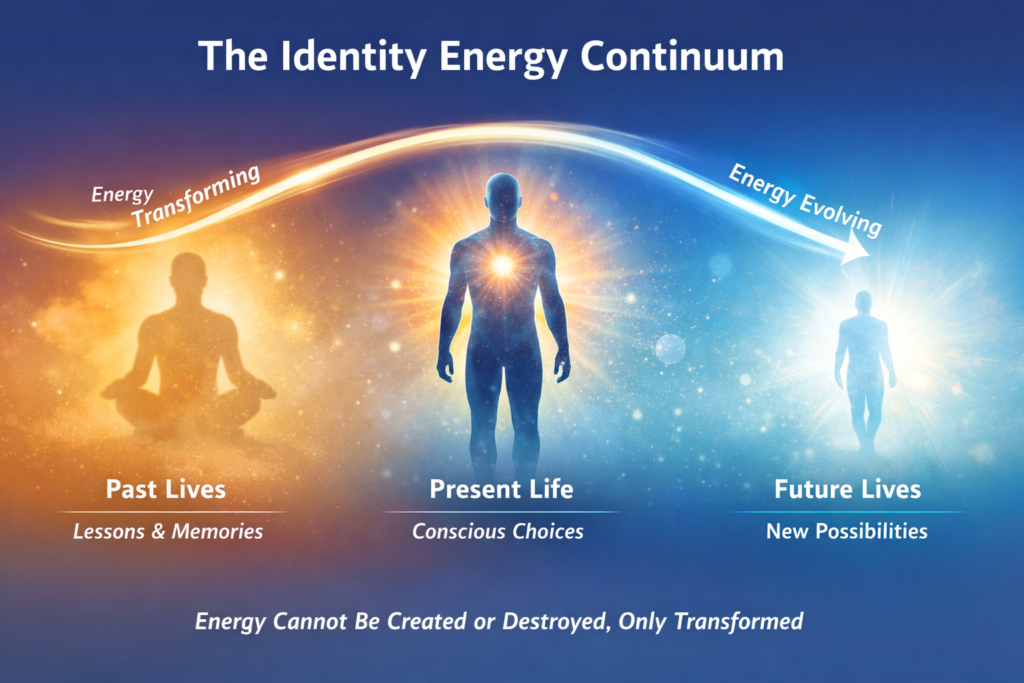
8. The Identity Energy Continuum: A Unified Model
The Identity Continuum reframes human existence as:
Past Lives → Present Life → Future Lives
A single, continuous arc of identity expressing itself through evolving module sets.
- Past Lives: Lessons & patterns
- Present Life: Choice & alignment
- Future Lives: Programmable destiny